
Design-for-Test at the Speed of Silicon
Empower. Collaborate. Accelerate.
Modern SoC designs are increasing in scale and complexity—driven by advanced
process nodes, heterogeneous integration, and chiplet-based architectures. As a
result, Design-for-Test (DFT) requires handling significantly larger and more
complex test content, especially for structural patterns generated through ATPG
flows.
In today’s workflows, preparing this test content for production remains a
fragmented process. Patterns are generated, converted, and adapted across multiple
environments before they can be executed on ATE systems. This introduces additional
steps, dependencies, and iterations—making it harder for DFT engineers to
efficiently validate and refine test content before production.
What Slows Down DFT Pattern Readiness for Production
Bringing DFT content to production is not limited by pattern generation—but by how
efficiently it can be validated and refined across engineering environments.
To enable early validation, teams rely on various bench setups—ranging from custom
FPGA-based platforms to adapted digital instruments. While these allow earlier
execution, they typically remain separate from the overall workflow,
introducing
fragmentation.
As a result, three key challenges slow down production readiness:
-
Long validation cycles
Limited visibility into test behavior delays analysis and refinement -
Repeated iterations and misalignment
Differences between tools, formats, and environments drive additional refinement -
Reduced productivity across teams
Dependencies and handoffs between DFT and Test Engineering slow down progress
These challenges stem from a lack of continuity across the workflow—from early bench validation to production.
The Unified DFT Engineering Experience on the Bench
SiConic® DFT Engineering brings execution, analysis, and refinement into a
single, continuous workflow on the bench.
It integrates with existing DFT toolchains and workflows, allowing engineers
to work with familiar test content and formats while extending their
validation capabilities onto the bench.
Instead of working across disconnected environments, DFT engineers can
operate within one integrated setup, maintaining full context from execution
through to production readiness.
Test content is executed in a production-relevant context, with results
immediately accessible and refinement performed within the same environment.
This enables engineers to work independently, iterate efficiently, and
maintain full control across the DFT workflow.
Validation on the bench remains consistent with production test
environments. Test content, results, and refinements translate directly into
production flows, making the transition to V93000 a continuation, not a
restart.
The result: faster convergence to production-ready patterns—with fewer
interruptions along the way.
Powered by the SiConic® Ecosystem
The unified DFT engineering experience is enabled by tightly integrated components within the SiConic® ecosystem.
-
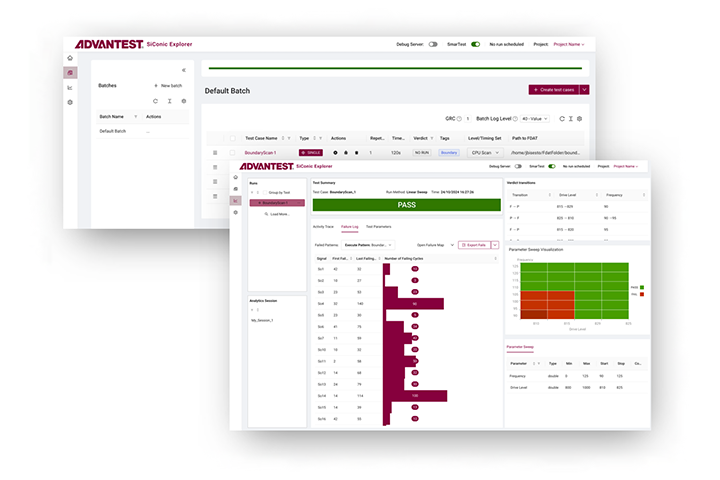
SiConic® Explorer
Provides a DFT-centric environment to execute, analyze, and interact with test content on the bench
-
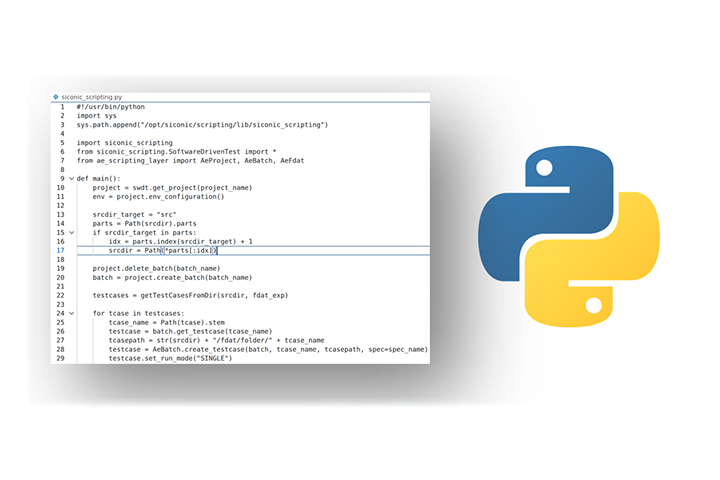
SiConic® Script
Enables automation and repeatability—allowing engineers to scale validation workflows and iterate efficiently
-
SiConic® D200
Delivers production-relevant digital execution with precise control of signals, timing, and clocking on the bench
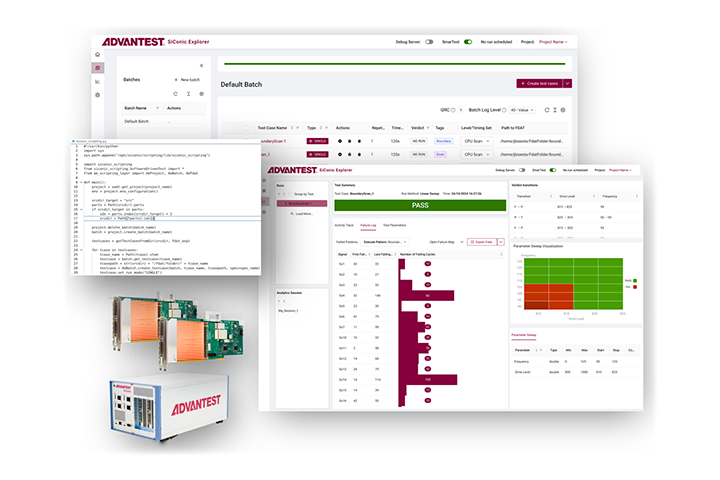
Together, they create a continuous workflow—connecting execution, analysis, and refinement in a consistent environment, enabling a direct path from bench validation to production.
