
We understand the impacts our business activities have on the planet's environment and we carry out activities to reduce our environmental impact. This page introduces our initiatives for environmental conservation.
Green Products
Basic Stance
Contributing to the sustainable development of society and conducting environmentally friendly business operations are essential issues that need to be addressed in modern business management. The Advantest Group works to develop products from the perspective of environmental conservation while prioritizing high precision and high quality, and certifies as green products those products that are environmentally friendly in terms of the three key aspects of energy and resource saving, improving recyclability, and elimination of hazardous substances. There is demand in society for the supply of green products because they provide both a reduction in the environmental footprint and an improvement in economic value. The Advantest Group has been promoting business activities based on the belief that providing green products will be in response to these demands and beneficial for its customers since 2005.
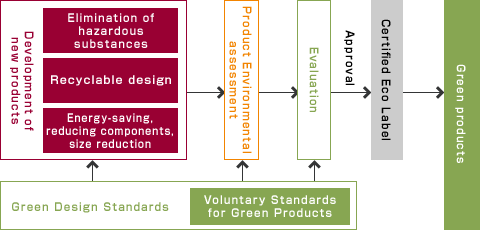
Development Flow of Green Products
At the Advantest Group, all products undergo a product environmental assessment.
During the product environmental assessment, products are assessed from various aspects, including energy-saving, reduction of the number of components, size reduction, recyclable design, and elimination of hazardous substances.
New products that meet the Voluntary Standards for Green Products defined by Advantest are certified as green products and are awarded with an Eco Label (type II), in addition to the product environmental assessment. We design new products to be 100% green products.
Advantest Group Eco Label
The Advantest Group Eco Label features an original three-color design representing energy and resource saving, recyclable design, and elimination of hazardous substances through green procurement.
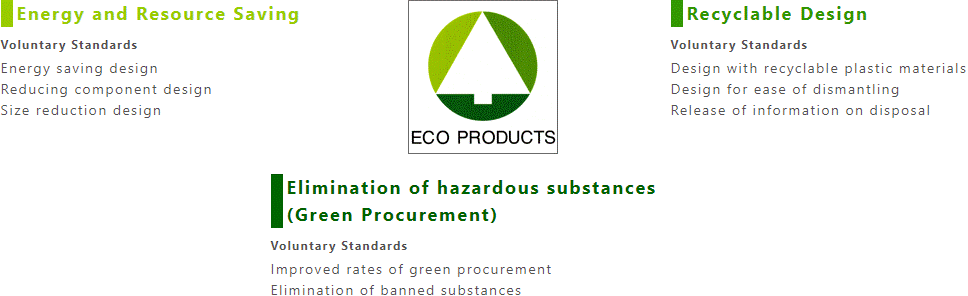
Energy and Resource Saving
We aim to reduce the environmental impact of our products through product designs that save energy, reduce components, and reduce size.
The reduction rate of energy against conventional products has been set to a standard of at least 20% for semiconductor test systems and measurement instruments, and at least 10% for other products such as handlers and nanotech products.
We have also set a reduction rate of at least 10% in the same way for components and the miniaturization for all of our products.
Note: The above reduction ratios are values based on performance computation.
Recyclable Design
In recyclable design, we release information on parts that will require special attention during disposal, and plastic parts designed in-house use 90% or more recyclable materials. Moreover, we make sure that products are easy to dismantle with standard tools, and we use rechargeable batteries displaying a recycle symbol.
Elimination of Hazardous Substances (Green Procurement)
To eliminate hazardous substances from our products, we have established Group standards on banned substances based on the IEC62474 standard, and we conduct surveys of hazardous substances contained in parts and materials used in our products. Advantest is building a response system for some of its products and eliminating relevant chemical substances using the results of this survey because these chemical substances are regulated by the RoHS directive as of July 2017.
Our main products are semiconductor examining devices, which are not manufactured products. Therefore, our main products do not cause emissions of gases such as PFASs.
Green Products Certified During Fiscal 2024
In fiscal 2024, a total of seven products related to semiconductor test systems, test handlers, and electronic measurement and medical equipment were certified as green products.
Promoting Product Reuse/Recycling
Advantest has been engaged with product reuse/recycling activities through Advantest Pre-Owned Solutions Co., Ltd. (APO), our subsidiary. Along with APO, Advantest not only provides maintenance support for products, but also tries to respond to a variety of customer requests, until the products are no longer in use.
For customers who no longer need our products, Advantest contributes to "reduce" by purchasing them instead of simply disposing of them. Advantest also promotes the “reuse” of our products across our entire customer base network by reselling purchased equipment to other customers who have used it for a long time, or by providing parts.
If there is no demand for the equipment or parts, Advantest implements initiatives to "recycle" the equipment it takes back by sorting it into resource levels.
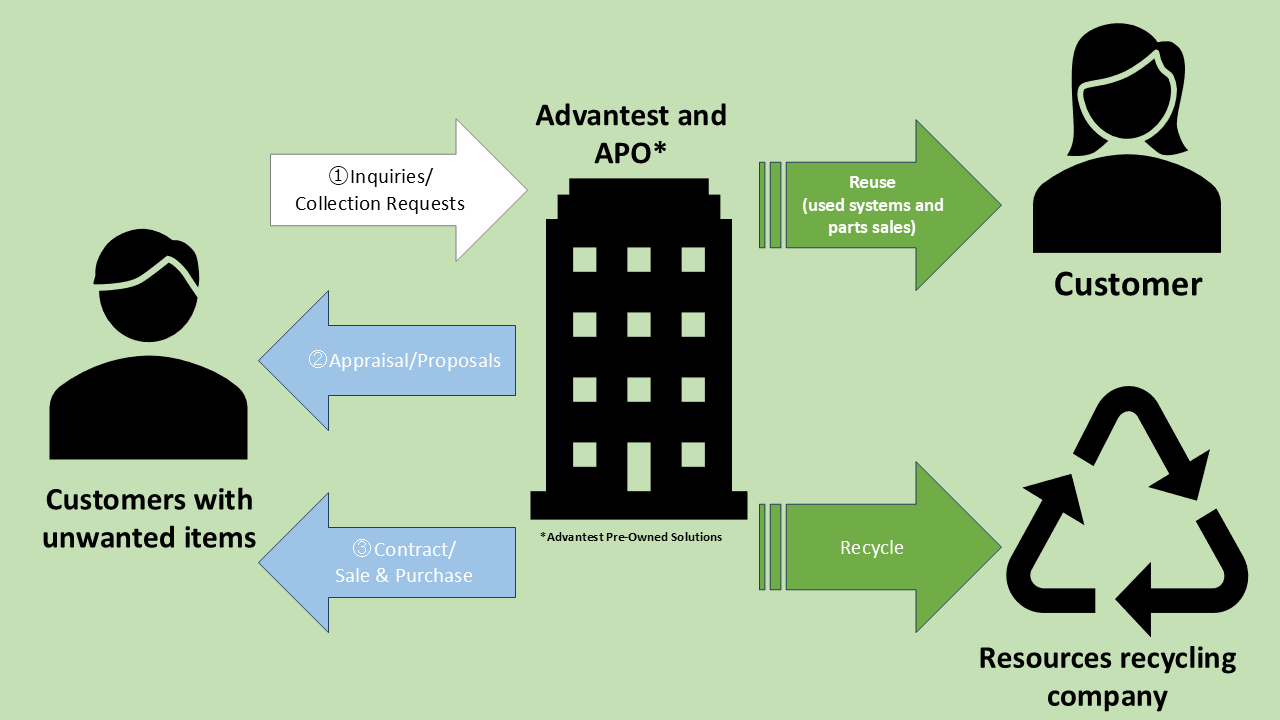
Product Reuse
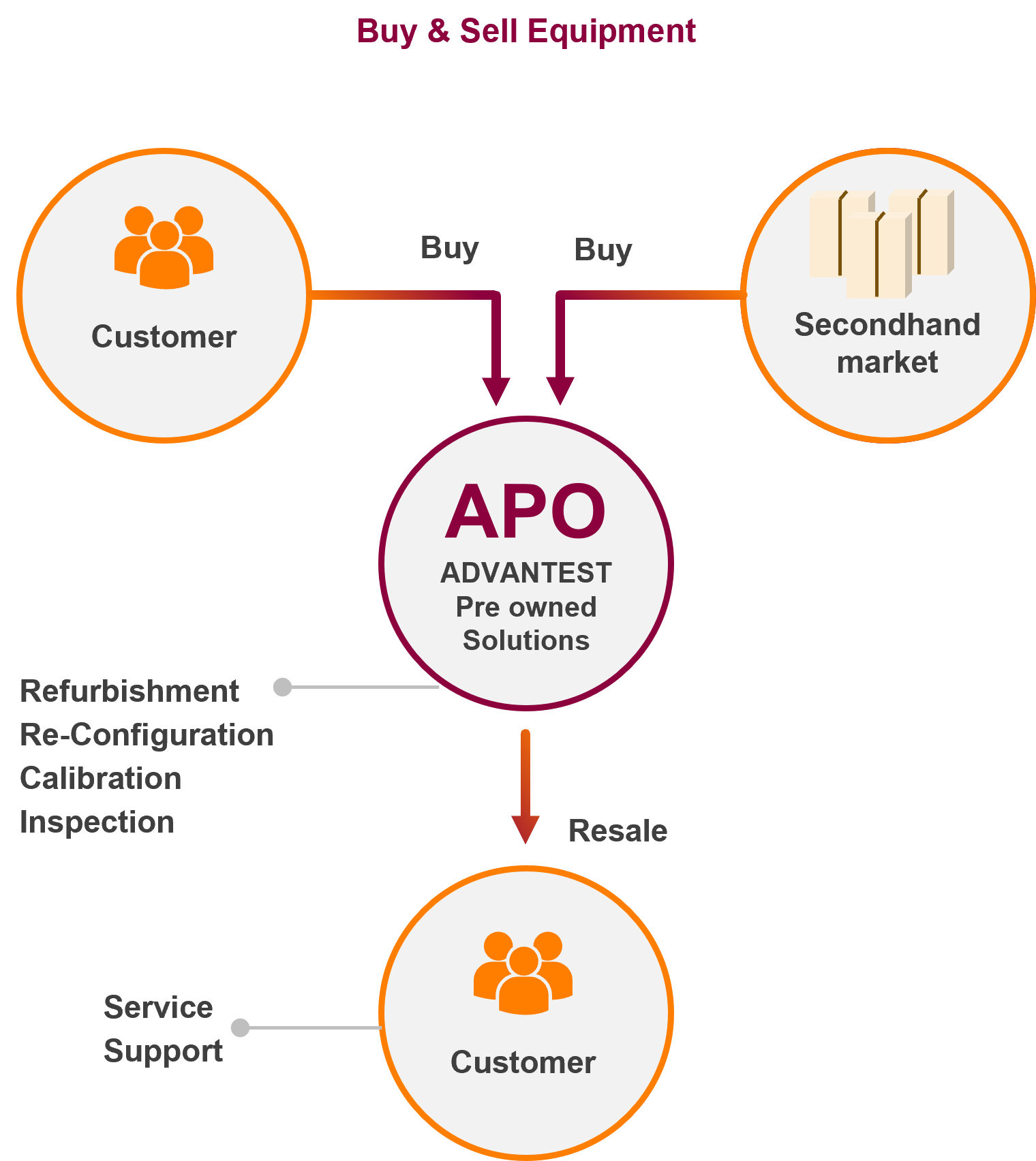
Advantest buys back and resells products through APO.
Advantest purchases equipment from customers who no longer need our products and resell it with a one-year warranty to customers who still wish to use it after our engineers modify specifications, check operation, and switch licenses. Advantest also provides maintenance support after sale, just as it does for new purchases.
Provide safe and secure used system with guaranteed performance
-
Buy back test systems from customer or market
-
Delivers refurbished and/or reconfigured equipment with the certified parts
-
Resale pre-owned test systems
-
Offers system installation and maintenance programs
Product Recycling
Basic Stance
It is the Advantest Group's basic policy to take active steps to ensure that the products we sell are recycled after they are retired. As a basic policy, we buy back products that are not expected to be reused so that the resources can be recycled.
Recycling policy
-
1.Achieve 100% collection of recyclables through manual dismantling.
-
2.Clarify to whom recycling is to be commissioned, and ensure traceability.
-
3.Promote the conservation of the global environment in collaboration with customers.
-
4.Properly dispose of harmful substances.
(Hazardous substances: mercury relay, ion type smoke detector, internal cooling water, and Fluorinert)
Recycling Results for Fiscal 2024
At the request of our customers, we engaged in resource recycling. The following is a list of the results.

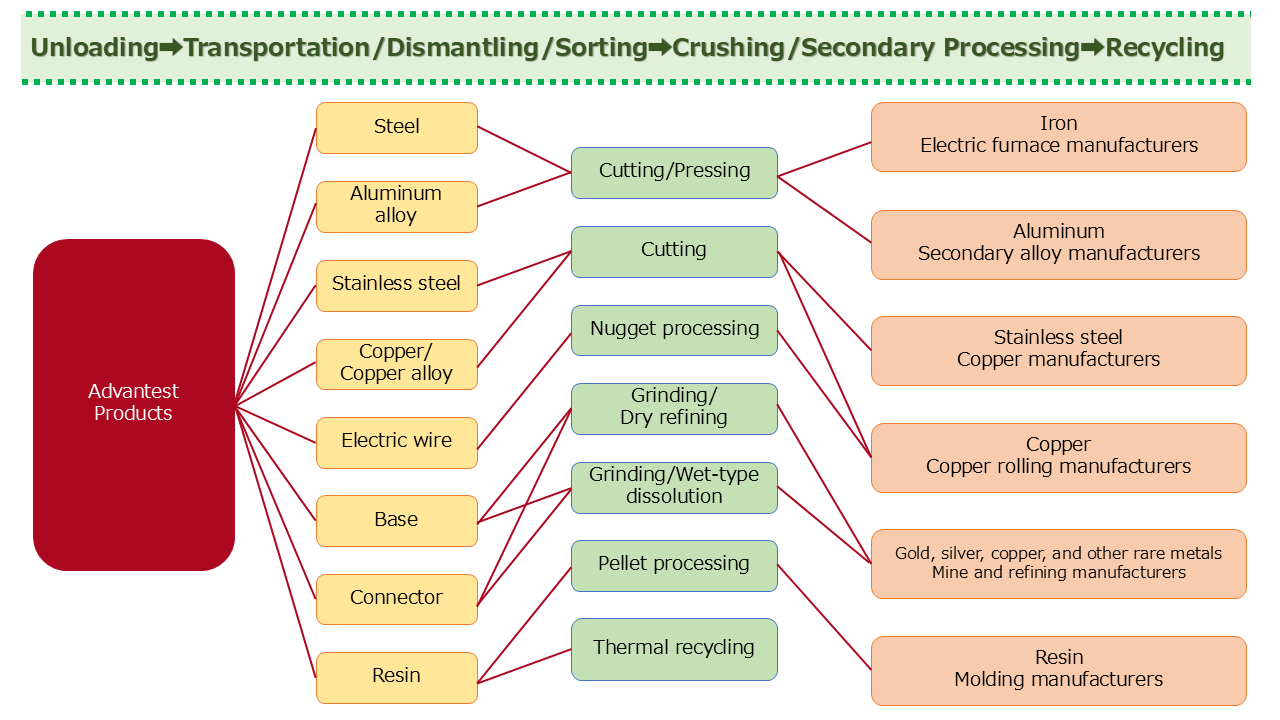
Advantest's product recycling system ensures proper disposal of used products, a high recycling rate (over 90%), and recycling of resources at reasonable costs.
Benefits for Customers
-
Based on the technical information of the products we have provided, expert staff at the recycling facility may dismantle and separate components containing valuable materials or hazardous substances and recycle them in an appropriate manner.
-
Upon request, Advantest may issue a "Recycling Certificate."
Currently, resource recycling is a domestic Japan-only solution, but we will continue consider its global applications and expand our activities.
Contact Information
Operational practices, quotes, individual contracts with customers, recycling cost reimbursement, etc.
Advantest Pre-Owned Solutions Co., Ltd. (APO)
(Secondhand dealer license: Tokyo Metropolitan Public Safety Commission No.301011008681)
Initiatives to Address Supply Chain Emissions
Efforts by individual companies alone to address climate change will have only a limited effect, which prompts us to engage in initiatives involving the entire supply chain and industry associations. The Advantest Group will proactively work to reduce our environmental footprint over the mid- to long-term through our supply chain in order to reduce supply chain emissions.
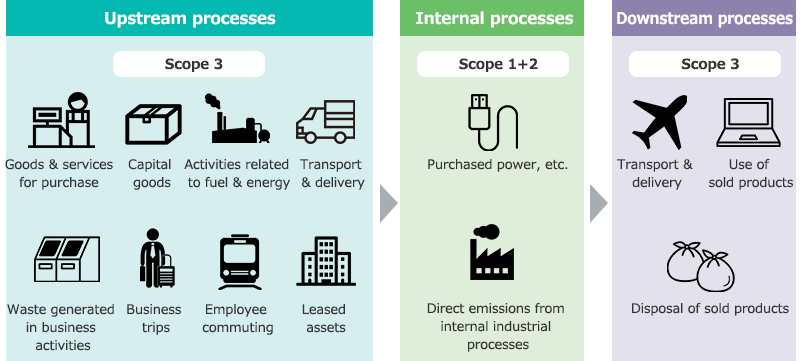
Supply chain emissions = Scope 1, 2 and 3 emissions
Task Force to Promote Supply Chain Emissions Reduction Activities
In fiscal 2021, we established a dedicated task force to drive supply chain emissions reduction initiatives. To achieve its targets certified by the Science Based Targets initiative (SBTi), the Company is promoting greenhouse gas (GHG) emissions reduction efforts not only within its own operations (Scope1 and Scope2), but also across its entire supply chain.
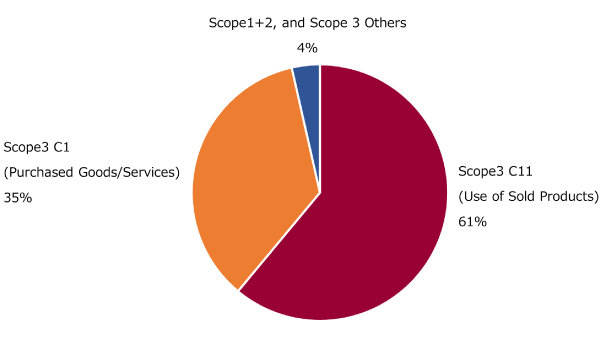
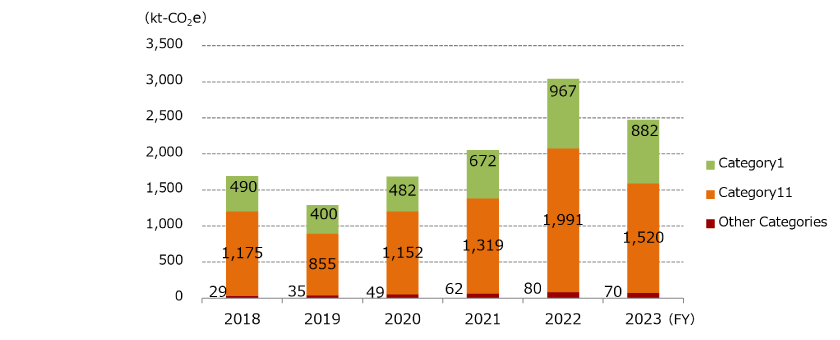
The majority of our Scope3 emissions are derived from Category 1: Purchased Goods and Services and Category 11: Use of Sold Products. Accordingly, in addition to reducing Scope1 and Scope2 emissions from our own operations, we have identified emissions reductions in these key categories as a priority issue and are actively implementing initiatives to address them.
(1) Task Force 1: GHG Emission Reduction Activities Through Product Development (Scope3 Category11)
Sustainability Action Plan 2024-2026
Task Force 1 works closely with global R&D organizations to promote GHG emissions reductions through product development. Under our Sustainability Action Plan, we have established the enhancement of product environmental performance as a key objective and use the GHG emissions reduction rate per AT Innovation as a key performance indicator (KPI). In fiscal 2025, we achieved an 88% reduction, demonstrating steady progress toward our target.
Going forward, we will continue to enhance product performance and improve energy efficiency to achieve our fiscal 2026 target, thereby contributing to the reduction of GHG emissions generated during product use.
(2) Task Force 2: GHG Emission Reduction Activities Through Cooperation with Business Partners
Sustainability Action Plan 2024-2026
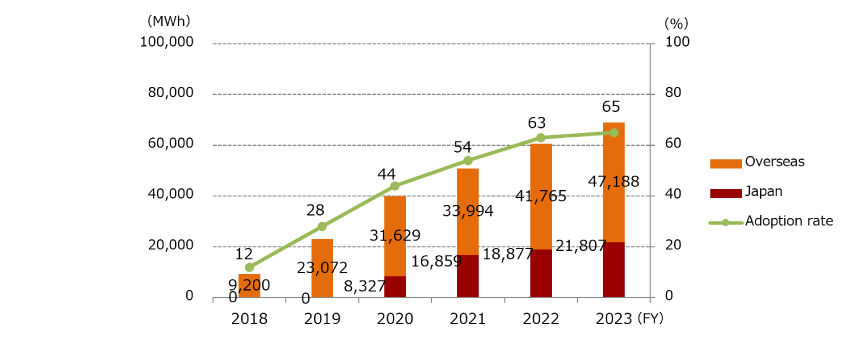
Task Force 2 works closely with the procurement function to promote GHG emissions reductions by expanding the use of renewable energy among suppliers. Under our Sustainability Action Plan, we have established the decarbonization of the supply chain as a key objective and use the renewable energy adoption rate among key suppliers as a key performance indicator (KPI). In fiscal 2025, the adoption rate reached 50%.
To achieve our fiscal 2026 target, we continue to encourage key suppliers to adopt renewable energy. As part of these efforts, we conduct an annual Supply Chain CSR Survey targeting major suppliers. Through this survey, we assess the status of renewable energy adoption and provide individualized feedback based on the analysis and evaluation of survey results.
These activities help raise awareness of the importance of emissions reductions and support the expanded use of renewable energy throughout the supply chain. In addition, the current methodology for calculating Scope3 Category 1 emissions is primarily based on procurement spending, which makes it difficult to adequately reflect suppliers' actual emissions reduction efforts. Going forward, we will explore the development of a calculation methodology that incorporates suppliers' Scope1, Scope2, and Scope3 emissions data. Through closer collaboration with suppliers, we aim to further advance emissions reduction efforts across our supply chain.
(3) Task Force 3: GHG Emissions Reduction Through Collaboration with Our Customers
Task Force 3 works closely with the sales organization to promote GHG emissions reductions through collaboration with customers. Through ongoing dialogue with customers, we share information regarding climate change policies and targets, as well as their expectations and requests for Advantest.
Based on these discussions, we strengthen collaboration with customers as a member of the supply chain and contribute to the reduction of GHG emissions. In addition, we strive to create sustainable value by incorporating customer expectations and requirements into our business strategy and sustainability initiatives. At the same time, a challenge remains in the current methodology for calculating Scope3 Category 11 emissions. Under the existing approach, emissions are calculated primarily based on the number of units sold, making it difficult to adequately reflect customer efforts to reduce emissions, such as expanding the use of renewable energy. Going forward, we will explore calculation methodologies that can better incorporate customers' renewable energy utilization and pursue further opportunities to reduce emissions through closer collaboration with our customers.
(4) Task Force 4: GHG Emissions Reduction Activities in Business Operations
Sustainability Action Plan 2024-2026
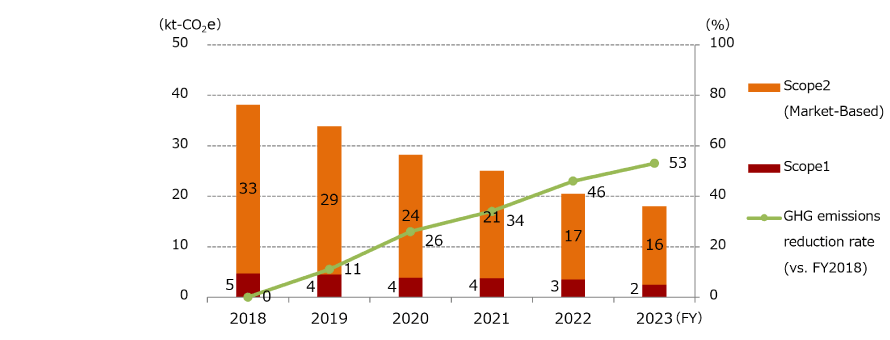
Task Force 4 promotes the reduction of greenhouse gas (GHG) emissions associated with business operations through the introduction of energy-efficient equipment and the expanded use of renewable energy. Under our Sustainability Action Plan, we have established targets for reducing Scope1 and Scope2 GHG emissions and increasing the adoption of renewable energy. The GHG emissions reduction rate and renewable energy adoption rate have been set as key performance indicators (KPIs) to measure progress toward these goals. In fiscal 2025, we further accelerated the adoption of renewable energy at our sites in South Korea. As a result, we achieved a 76% reduction in GHG emissions and an 88% renewable energy adoption rate, exceeding our fiscal 2026 targets for both indicators.
Looking ahead, further expansion of renewable energy use will be essential to achieving additional emissions reductions. However, in certain regions, including South Korea, Taiwan, and Singapore, the limited availability of renewable energy continues to present procurement challenges. We expect that ongoing advocacy efforts through our participation in RE100 will help encourage governments to expand renewable energy supply. At the same time, we will continue to monitor market developments and assess procurement opportunities in each region while exploring measures to further increase the adoption of renewable energy across our global operations.
-
*1Please refer to "Management" for the list of CxOs.
-
*2GHG emission per AT innovations is calculated by dividing Scope 3 Category 11 GHG emission by AT innovation (number of transistors based on Advantest's market share, pins, frequency, DPS current in systems that account for 80% of annual sales, and number of the systems).
-
*3The top 85% of suppliers by transaction value are defined as main business partners.
Climate change initiatives at our domestic locations
Introduction of Renewable Energy
Advantest initiated its transition to renewable electricity in 2021 by converting the power used at its Gunma Factory to 100% renewable energy. The Company subsequently expanded the use of renewable energy to its Headquarters, Gunma R&D Center, Saitama R&D Center, and Sendai Laboratory. Today, almost all electricity consumed at its domestic sites is sourced from renewable energy, significantly reducing greenhouse gas emissions and supporting the transition to a decarbonized society.
Climate change initiatives at our overseas locations
Introduction of Renewable Energy
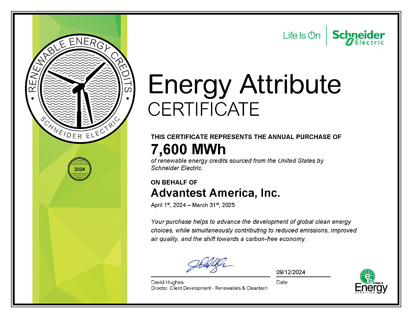
At Advantest America, Inc. (AAI), efforts to expand the use of renewable energy have been underway since 2012. By utilizing Green Power Certificates generated from wind energy, AAI sources 100% of the electricity consumed at its facilities from renewable energy. Since 2012, AAI has also participated in the U.S. Environmental Protection Agency's (EPA) Green Power Partnership program, continuously contributing to the development and wider adoption of the green power market through increased use of renewable energy.
Furthermore, in January 2025, AAI installed a solar power generation system at its facilities in Arizona. This initiative is helping to reduce AAI' s greenhouse gas (GHG) emissions while also contributing to the stability of the local electricity supply and demand. Through these efforts, AAI continues to advance its decarbonization initiatives and support the transition to a more sustainable energy future.
(United States)
At Advantest Europe GmbH (AEG), renewable energy has been utilized since 2019. Through the use of renewable energy sources, including solar power generation, 100% of the electricity consumed at its facilities is supplied from renewable energy. By expanding the use of renewable energy, AEG is contributing to the reduction of greenhouse gas emissions and supporting the transition toward a decarbonized society.
(Germany)
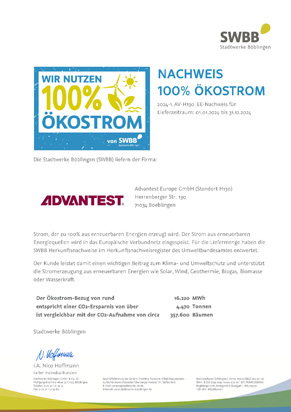
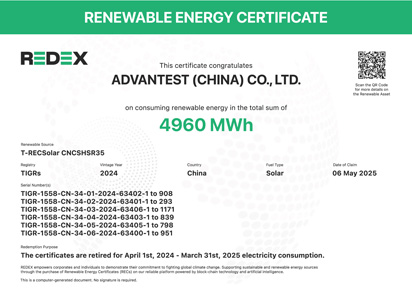
Advantest (China) Co., Ltd. (ATC) has utilized renewable energy since 2022. Through the use of Green Power Certificates generated from solar energy, 100% of the electricity consumed at its facilities is supplied from renewable energy sources. By expanding the use of renewable energy, ATC is reducing greenhouse gas emissions and contributing to the realization of a decarbonized society.
(China)
Recycling Resources
The Advantest Group pursues operations encompassing the "3Rs" (reduce, reuse, and recycle) with the aim of realizing a recycling society.
Waste recycle initiatives
The Advantest Group is committed to converting waste into valuables by reinforcing the initiative we launched in FY2009 to separate components. We ensure strict compliance in these activities.
In disposing of waste (including packaging materials) generated in our business activities, we clearly indicate to our outsourcing contractors the disposal method for each classification as per the relevant laws (including local laws and regulations) to ensure proper disposal and recycling by material type.
Trend in waste generated and recycling rate

-
*The amount of waste generated, and the amount of waste recycled in Japan were calculated excluding valuable materials.
-
*We found, through an inquiry to a waste disposal contractor, that some generated waste which had been allocated to the recycled quantity was not in fact recycled. We have recalculated and restated the past figures accordingly.
Efforts to Eliminate Plastic
For more than 15 years, Advantest Gunma Factory has used reinforced cardboard packaging to transport our products, such as test systems, contributing to the elimination of plastics and the reduction of waste. In addition, reinforced cardboards are also used for the pallets on which the products are mounted, thus achieving a reduction in plastics. Currently, plastic accounts for less than 6% of our packaging materials.
The cardboard boxes are manufactured in appropriate sizes with the cooperation of our cardboard suppliers, which serve vital roles in providing safe and efficient deliveries. Moreover, the cardboard boxes are about half the weight of the wooden boxes used in the past, not only contributing to reducing CO2 emissions during product delivery but also reducing the burden on employees since they are not just easy to pack, but are also easy to unpack at the shipping destination. A single cardboard packaging material is used only once for transporting a single product, and is recycled based on the rules of the customer.
Realizing a New Circulation Cycle with the Introduction of a Recycling Equipment
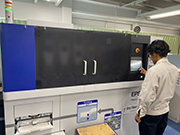
Advantest has installed a recycled paper manufacturing machine from 2020, which can produce new paper from used paper such as rejected documents. With this machine, most of the confidential documents to be disposed, which were hitherto collected and sent to a contractor for disposal, will be processed in-house, and given "new life" by being recycled into paper and made use for various purposes, such as business cards.
We also made notebooks using recycled paper and gave them as gifts to local elementary school students who visited our biotope for nature observation events, as well as to special-needs school students and teachers who paid a visit during our company tours. These help in view of our social contributions by providing teaching materials for learning applications.
The equipment is operated by our employees with disabilities. It will also create more opportunities for people with disabilities to play an active role in the company. Once they embark upon their careers and showcasing their active roles as members of the Advantest Group will prove to be a way to repay their alma mater. With the introduction of the new paper manufacturing machines, Advantest has realized a new circulation cycle through various aspects such as environmental commitment, employment of people with disabilities, and educational support.
For more information on employment of the disabled, please refer to "Efforts to Promote Diversity".
recycled paper

manufacturing machine
Proper Disposal of Waste Plastics and Material Recycling
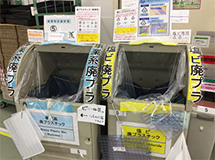
Advantest has been recycling all waste plastics at business locations in Japan.
At its Gunma Factory, trays and magazines, which are used as parts containers, are disposed of as waste plastics.
Individual employees check the recycling identification mark on each container to sort containers containing PVC.
This allows waste plastics to turn into the main raw material for RPF (Refuse Paper & Plastic Fuel), which is a high-quality solid fuel.
Waste plastics containing PVC are crushed, incinerated, and recycled as molten slag, which is used mainly as roadbed material.
Proper Disposal of Equipment Containing PCB
Advantest owned three capacitors, fluorescent lights, and stabilizers that contained polychlorinated biphenyls (PCBs), but all pieces of the equipment that contained PCBs were properly disposed of during FY2017.
Effective Use of Water Resources
Advantest's main usage applications of its water resources are the operation of air conditioners, kitchen use, toilet cleaning, and drinking. At our main bases, we use water for industrial use efficiently. In addition to using this water for cleaning the toilets, we also use it with sprinklers on the roof to improve cooling in the summer. Advantest is also filtering drinking water and using ultra-pure water at some business establishments. It should be noted that most of the discharged water produced by Advantest Group is classed as domestic sewage. Currently, domestic sewage and rain water cannot be recycled.
Of course, every member of our staff takes care not to waste water, and strives to make effective use of our water resources.
Trend in water usage/discharged water
